Skip to content
Vaccarezza Racing

Nobody in this business will tell you what it costs.

Every trainer’s website invites you to “inquire about ownership,” which means filling in a form and waiting to be sold to. So most people who were curious never call, and the sport keeps wondering where its new owners went.

Here is how it works, in the order you would ask.

Three ways in

Claim a horse

You buy a horse out of a race for a set price. It is running the day you buy it, so you are in the game immediately and you can see exactly what you are getting — it has a form line.

Time to a first start
Days. It is already in training and race-fit.
Suits you if
You want to find out whether you actually like this before committing to a long timeline, and you would rather own a horse that runs than a prospect that might.
The catch
Claiming horses are claiming horses for a reason. You take the horse as it is, soundness and all, the moment the gate opens — no vetting, no returns.
A two-year-old in training

Bought at a two-year-old sale, where the horses breeze in front of buyers first. You see it move before you bid, and it is close to being ready to run.

Time to a first start
Months. Most start late in their two-year-old season.
Suits you if
You want real upside and the experience of developing a young horse, without the two-year wait a yearling costs you.
The catch
A fast breeze is not a race. Plenty of horses who work brilliantly in March never run to it in company.

A yearling

You buy on pedigree and physique and raise the horse yourself, through breaking and early training, into its two-year-old year.

Time to a first start
Roughly eighteen months before it sees a starting gate.
Suits you if
You are in it for the whole story and you can carry the horse for a year and a half before it can possibly repay you.
The catch
The longest, most expensive road, and the one with the most chances to go wrong before you ever get an answer.

What any of these costs on the day depends entirely on the horse. Nick will give you real numbers against real horses on a call.

Then it costs money every single day

What the day rate covers

A flat charge per horse, per day, whether it runs that month or not. It is what keeps the staff paid and the horse fed.

  • Stall, bedding and feed
  • Your horse's share of the grooms, hotwalkers and exercise riders
  • Daily training, galloping and works
  • Routine daily care and observation
  • The trainer's time, judgement and supervision

What gets billed on top of it

This is the list nobody puts on a website, and it is the reason first-time owners get a bill they were not expecting.

  • Veterinary

    Routine and otherwise. The single most variable line on any owner's bill, and the one that surprises people.

  • Farrier

    Shoeing on a regular cycle, plus anything corrective.

  • Shipping

    Van costs between tracks. A Kentucky stable that ships to Ellis in summer and Gulfstream in winter moves horses several times a year.

  • Jockey mounts

    A riding fee every time the horse runs, plus 10% of the purse to the jockey when it wins.

  • Entry and nomination fees

    Ordinary races are cheap to enter. Stakes races are nominated and paid for well in advance.

  • Licensing and registration

    You will need an owner's licence in each state you race in, and the horse registered in your colours.

  • Insurance

    Optional, and worth discussing honestly relative to what the horse cost.

How Nick gets paid

A day rate per horse

Charged every day the horse is in the barn, whether it runs that month or not. This is how the staff get paid.

10% of purse earnings

The standard in North American racing. It is the part that aligns us: the trainer only does well when your horse does.

You will get an itemised bill every month. If a line on it does not make sense, the person who can explain it is the same person who set the horse’s work that morning.

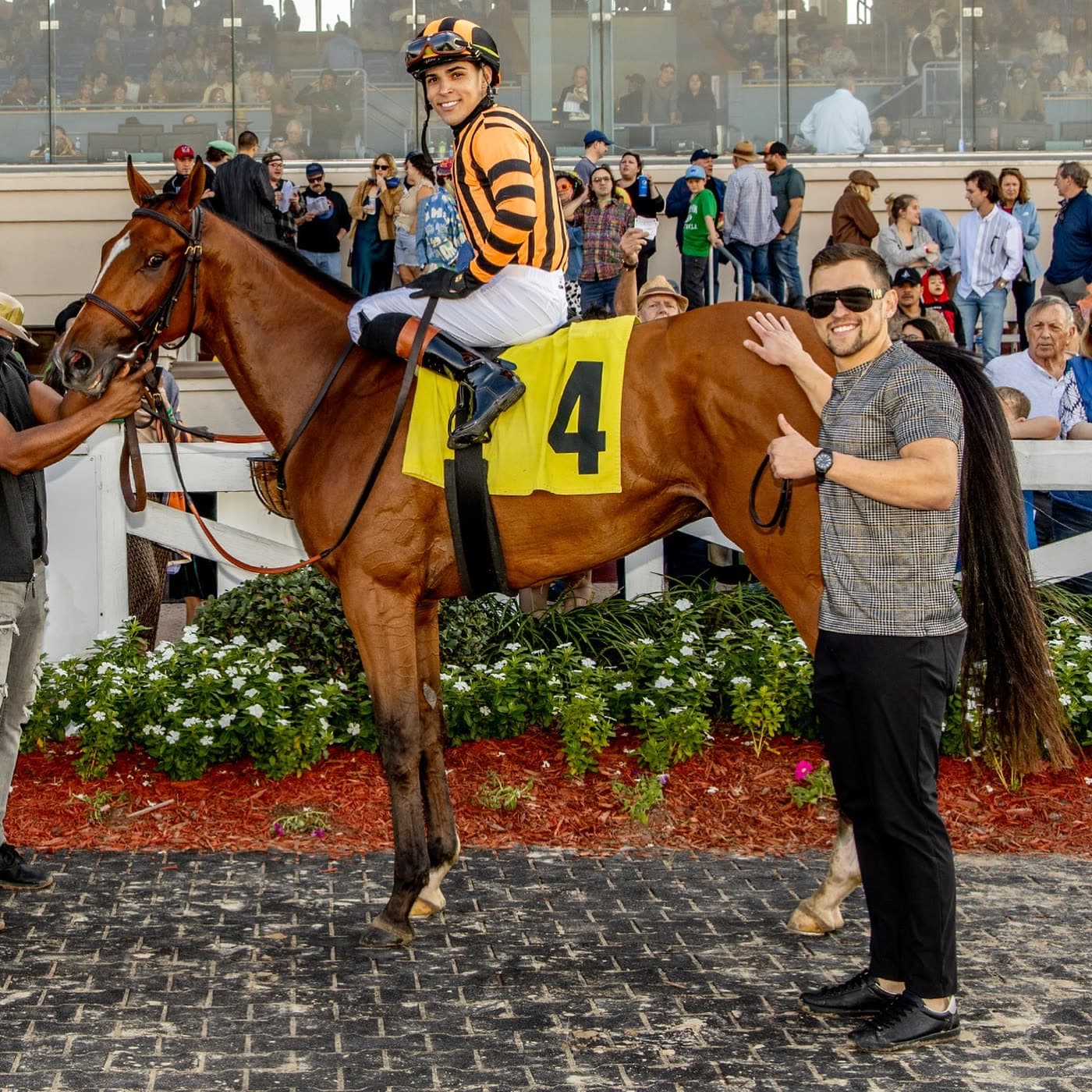
Nick Vaccarezza in the winner's circle, a hand on the horse's shoulder, the jockey still up
The winner’s circle — about nine minutes out of a year.

Decide the number first.

Before you look at a single horse, settle on what you are willing to put into this over a year — the purchase, and then twelve months of everything above. Owners who set that number at the start enjoy the whole thing. Owners who work it out afterwards spend the season doing arithmetic instead of watching their horse. Nick will tell you what a given horse is likely to cost you before you buy it, not after.

The next step is a morning, not a brochure.

Come to the barn. Training starts before light, you will watch a set go out, and you can ask every question on your list of the person who will actually be training your horse. It takes about thirty minutes and it costs nothing. Wear boots.